So much to know about this beautiful and historic place
A disclaimer to begin with. I’m not a history buff. It’s not my best category in a pub quiz. I can’t recall all the Kings and Queens of England as a party trick. And yet, here I am living close to Cartmel, a place of such historical significance. History adds such a richness to this part of the Lake District. Perhaps you want to know a bit more…?
Here are just a few interesting facts about Cartmel Priory history to tempt you to visit. Believe me, there is so much more.
1. Cartmel Priory is a survivor
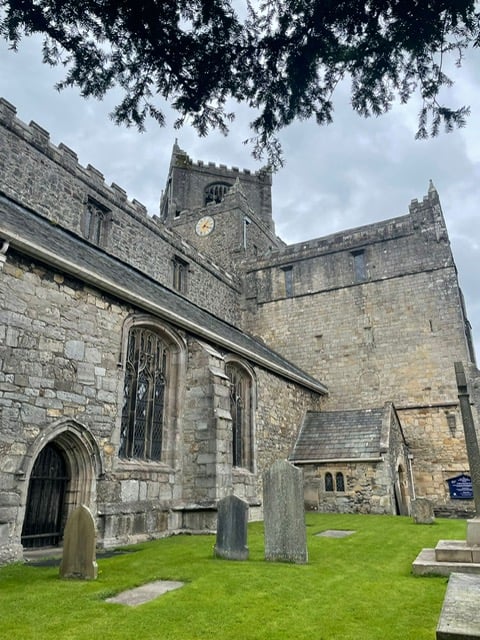
The Priory was founded in 1189 by William Marshal (more about him later). It is both a priory (where Augustinian monks were invited to settle) and a parish church, but it looks like a small cathedral to me. It escaped Henry VIII’s purge and destruction of monasteries. This was probably because it was named ‘The Priory Church of St Mary and St Michael’, a parish church. It slipped under the dissolution radar and has remained a place of prayer and community for all this time.
It may have been the most fortuitous administrative glitch ever. Just step inside and find yourself enthralled by this sacred, spiritual space. For me, it’s as if I can feel the thousands of prayers that have been said there. Light a candle there in memory of someone close to you (at the back of the Priory). Connect yourself to the centuries of worship here, the faith story of this part of the world.
2. Spot the Norman arches
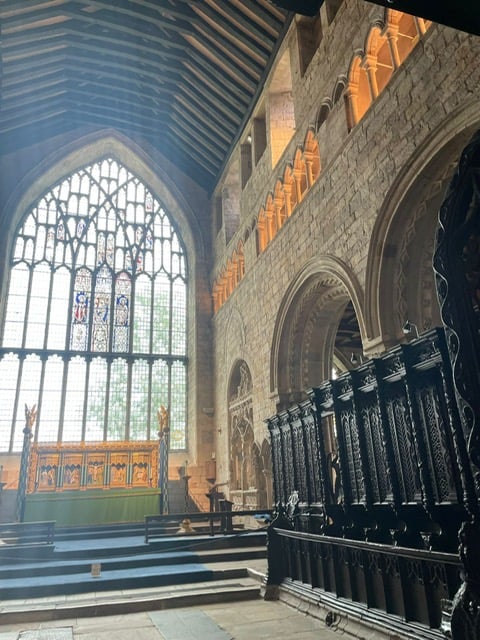
There’s so much architectural treasure within Cartmel Priory and there are some helpful volunteer guides to show you round and point things out. As you enter, you will find a welcome guide at the Cartmel Priory Bookshop. They love to help visitors enjoy the Priory.
I love the stained glass windows which tell stories and bring in the light, to reflect the times of day and the seasons. On winter evenings, at choir practice, the Priory is lit up with candlelight and music.
Here’s another thing to try. You can really get to know the history of the place by noticing the different arches. In simple terms, arches which are rounded and semi-circular date from the Norman period (1066 to 1154) – the oldest part of the Priory. Pointed Gothic arches were created later (early 1140s to early 16th century) and so are beautiful additions. Just noticing the arches gives you a real sense of time and place as you connect history you know from books to the living history of Cartmel Priory. It shows how the Priory developed architecturally through the ages. It seems to me to have always been a work in progress.
3. William Marshal – often referred to as the greatest knight
William Marshal’s life alone is so impressive that you will find books about his life, his power, his battle skills, two years in the Crusades, his achievements and status (check out the Cartmel Priory bookshop). He commissioned the building of the Priory and insisted that prayers be said constantly to ensure his safe return from the Crusades. It worked. He lived to the age of 73 in tumultuous times, when most people died young. 60 years of age was a good lifespan. He was a giant in his time in more ways than one. At 6 feet 2 inches, he always stood out. Perhaps his most impressive contribution is his involvement in the creation and signing of the Magna Carta.
4. The Magna Carta Connection
William Marshal died in 1219 and yet just 4 years before, he was involved in the signing of the Magna Carta (1215). He is credited with persuading King John to sign this important historical document against opposition. Essentially, he brokered the deal. No mean feat. As you probably know, this document is both a symbol and a historical record of the importance of the rule of law, trial by jury and the accepted basis for human rights. There was much wrangling between King John and some powerful English barons to achieve the agreement. Without William Marshal, it’s thought that it may never have been signed. This alone makes William Marshal worthy of great honour historically.
Cartmel – not just a racecourse. Not just Sticky Toffee Pudding
Cartmel itself is still just a village. It is an easy place to walk round but I believe that Cartmel Priory is really the historic jewel in its crown. I hope this makes you curious about Cartmel Priory’s history. Take a tour round the Priory and step back in time. There is so much more to know. Here’s hoping I have piqued your curiosity?
Interested in reading about some other local gems – take a look here or if you’d like to read about Arts and Heritage in the area, check out this blog.
Kath, co-host at the Pheasant Lodge